Daikon
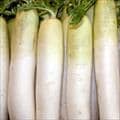
Daikon (Raphanus sativus) aka: winter radish, Japanese Radish, Chinese Radish, mooli, moolah, lo-bok, labanos, rabu, phakkat-hua, củ cải trắng, is a large white tube shaped vegetable with a green leafy top.
Health benefits of Daikon
- Increased Protection from Bacterial and Viral Infections
- Increased Immune Function
- Reduced Cancer Risk
- Reduced Risk of Colon Cancer
- Protection Against Heart Disease
- Regulation of Blood Sugar and Insulin Dependence
- Slowing the progression of AIDS
- Slowing Aging
- DNA Repair and Protection
- Protection Against Dementia
- Alleviation of Cardiovascular Disease
- Alleviation of Hypertension (High Blood Pressure)
- Promoted Eye Health
- Alzheimer's Protection
- Osteoporosis Protection
- Stroke Prevention
- Reduced Risk of Type II Diabetes
- Reduced Frequency of Migraine Headaches
- Alleviation of Premenstrual Syndrome (PMS)
- Antioxidant Protection
- Prevention of Epileptic Seizures
- Alleviation of the Common Cold
- Prevention of Alopecia (Spot Baldness)
- Alleviation of Inflammation
Some of these health benefits come from nutrients concentrated in this food, and may not be effects of the food itself.
How to choose Daikon
Look for firm roots with no signs of wilting, if the green tops are still attached try to make sure they are not wilted.
How to store Daikon
Cut the top off the Daikon to help keep moisture in the roots, store the Daikon in a plastic bag in the fridge and they should last for up to two weeks if not more. A wet paper towel can also be placed in the bag to help maintain humidity and keep the roots from wilting.
Climate and origin
Daikon is thought to have originated in the Mediterranean, and later spread to Asia. Daikon is a winter vegetable that is able to tolerate cold temperatures.
Taste
Daikon has a slightly sharp taste with a crisp texture that softens during cooking.
Miscellaneous information
The word Daikon literally means large (dai) root (kon).
Similar tasting produce
Nutrition facts
| Nutrition Facts | |||
|---|---|---|---|
| Serving Size | |||
| 100 grams (100g) | |||
| Calories | 18 | ||
| % Daily Value * | |||
| Total Fat 0.1g | 0% | ||
| Saturated Fat 0.03g | 0% | ||
| Trans Fat 0g | |||
| Cholesterol 0mg | 0% | ||
| Sodium 21mg | 1% | ||
| Total Carbohydrate 4.1g | 1% | ||
| Dietary Fiber 1.6g | 6% | ||
| Total Sugars 2.5g | 5% | ||
| Includes --g Added Sugars | --% | ||
| Protein 0.6g | 1% | ||
| Vitamin C 22mg | 24% | ||
| Vitamin D 0mcg | 0% | ||
| Iron 0.4mg | 2% | ||
| Calcium 27mg | 2% | ||
| Potassium 227mg | 5% | ||
| Phosphorus 23mg | 2% | ||
| *The % Daily Value (DV) tells you how much a nutrient in a serving of food contributes to a daily diet. 2,000 calories a day is used for general nutrition advice. | |||