Watercress
Watercress (Nasturtium officinale) is a dark green vegetable with rounded leaves attached to a long stem.
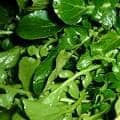
Health benefits of Watercress
- Increased Protection from Bacterial and Viral Infections
- Increased Immune Function
- Reduced Cancer Risk
- Reduced Risk of Colon Cancer
- Protection Against Heart Disease
- Regulation of Blood Sugar and Insulin Dependence
- Slowing the progression of AIDS
- Slowing Aging
- DNA Repair and Protection
- Protection Against Dementia
- Alleviation of Cardiovascular Disease
- Alleviation of Hypertension (High Blood Pressure)
- Promoted Eye Health
- Alzheimer's Protection
- Osteoporosis Protection
- Stroke Prevention
- Reduced Risk of Type II Diabetes
- Reduced Frequency of Migraine Headaches
- Alleviation of Premenstrual Syndrome (PMS)
- Antioxidant Protection
- Prevention of Epileptic Seizures
- Alleviation of the Common Cold
- Prevention of Alopecia (Spot Baldness)
- Alleviation of Inflammation
Some of these health benefits come from nutrients concentrated in this food, and may not be effects of the food itself.
How to choose Watercress
Look for bright vibrant leaves and avoid anything that looks withered or discolored.
How to store Watercress
Most watercress is sold with the roots still attached. If this is the case it is wise to wrap a wet cloth around the roots, and then place the entire watercress in a plastic bag and store it in the refrigerator. It will last for 1-2 weeks.
Climate and origin
Watercress originated in Europe, North Africa, and Asia. Preferring colder temperatures watercress is a winter crop that does well in temperate climates. (Zones 3-8 in the U.S.) Watercress grows as a weed in North America and Australia. If you find wild watercress, be sure you understand the quality of the water it is growing in before harvesting and eating.
Taste
Watercress has a strong sharp pungent taste and a crisp texture.
Miscellaneous information
Watercress was used during the 1700s to prevent scurvy in parts of the British Isles where people had to mostly subsist on meat.
Similar tasting produce
Mustard Greens, Turnips, Radishes
Nutrition facts
| Nutrition Facts | |||
|---|---|---|---|
| Serving Size | |||
| 100 grams (100g) | |||
| Calories | 11 | ||
| % Daily Value * | |||
| Total Fat 0.1g | 0% | ||
| Saturated Fat 0.03g | 0% | ||
| Trans Fat 0g | |||
| Cholesterol 0mg | 0% | ||
| Sodium 41mg | 2% | ||
| Total Carbohydrate 1.3g | 0% | ||
| Dietary Fiber 0.5g | 2% | ||
| Total Sugars 0.2g | 0% | ||
| Includes --g Added Sugars | --% | ||
| Protein 2.3g | 5% | ||
| Vitamin C 43mg | 48% | ||
| Vitamin D 0mcg | 0% | ||
| Iron 0.2mg | 1% | ||
| Calcium 120mg | 9% | ||
| Potassium 330mg | 7% | ||
| Phosphorus 60mg | 5% | ||
| *The % Daily Value (DV) tells you how much a nutrient in a serving of food contributes to a daily diet. 2,000 calories a day is used for general nutrition advice. | |||